


Housing Journal
11.24.26
From Local to State to Federal housing advocacy, NMHBA members shape the future of communities. Explore this month’s updates, trainings, industry insights, member resources, and opportunities to stay connected with the family businesses who build New Mexico’s housing future.
Featured in this November issue:
- Webinar 12/17 Mercatus Center new report: Tax Policy, Housing & New Mexico’s Comeback
- ABQ Event 12/14: Immigration Enforcement” Employers Rights, Responsibilities, Strategies for Protecting Your Business and Employees
- Get the Latest Updates on Immigration Enforcement in Free NAHB Webinar
- Housing Abundance Coalition (Our Housing Story Vid#1)
- Native Timber [Structural Lumber] and Single Stair Rule before CID Technical Advisory Committee
- Heinrich’s Bipartisan American Affordability and Jobs Act Opens Doors to Affordable Housing and Electrons to Power Them [SUPPORT]

This November Housing eJournal brought to you by Doc Savage Supply.
What’s Driving New Mexico’s Out-Migration?
Policy Fixes That Can Reverse It and Get New Mexico Building
Join Us December 17: 11:30AM
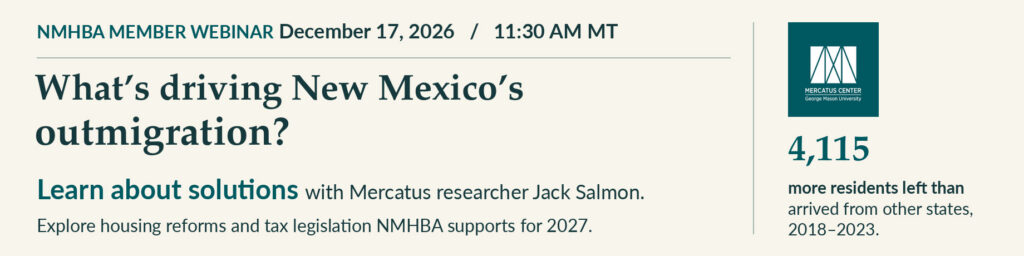
NMHBA members are invited to a webinar on December 17 with the Mercatus Center. We’ll hear from Gibbs Scholar and Research Fellow Jack Salmon and State Policy Manager Duncan Shroeder about their new Interstate Migration Series.
Mercatus research ranks all 50 states by the people and income they’re gaining or losing. He found that state growth is most closely tied to things legislators control: low taxes, flexible labor markets and high rates of housing permits. His policy guide for New Mexico breaks down where our state stands and recommends tax, labor and housing policies.
The webinar will cover what the findings mean for New Mexico. It will also look at how proposed tax legislation, which NMHBA is helping to craft and support in the 2027 legislative session, could help our state’s growth and its housing market.
Immigration Enforcement – Rights and Responsibilities to Protect Your Business and Employees

Join Us on December 14th at 11:30AM.
NMHBA is partnering with the National Association of Home Builders, NM Immigrant Law Center and El CENTRO de Igualdad y Derechos to deliver an in-person “train the trainer” style session on December 14th
Employer Rights, Responsibilities, Best Practice & Tactics to:
- Protect Your Employees and those of your Trade Partners (Subs)
- Protect Your Rights, Jobsites, and Business
- Know how to respond before, during, and after an immigration enforcement event
RSVP for 12/14 by calling 505-344-7072 or email info@NMHBA.org
As discussed during the Annual Meeting of the Members, Board directed staff to structure an IN-PERSON “train the trainer” session in such a way that members will be capable of – paying it forward – to inform and empower fellow contractors and trade partners who are unable to attend this session on best practices for inevitable enhanced immigration enforcement activities in the future.
In advance of the webinar, read When ICE Comes Calling, a NAHB resource for home builders that lays out business owners’ rights and responsibilities when it comes to immigration enforcement. The video below highlights some of the most important points from the document.
Housing Abundance! Coalition | Our Mission & What’s Ahead
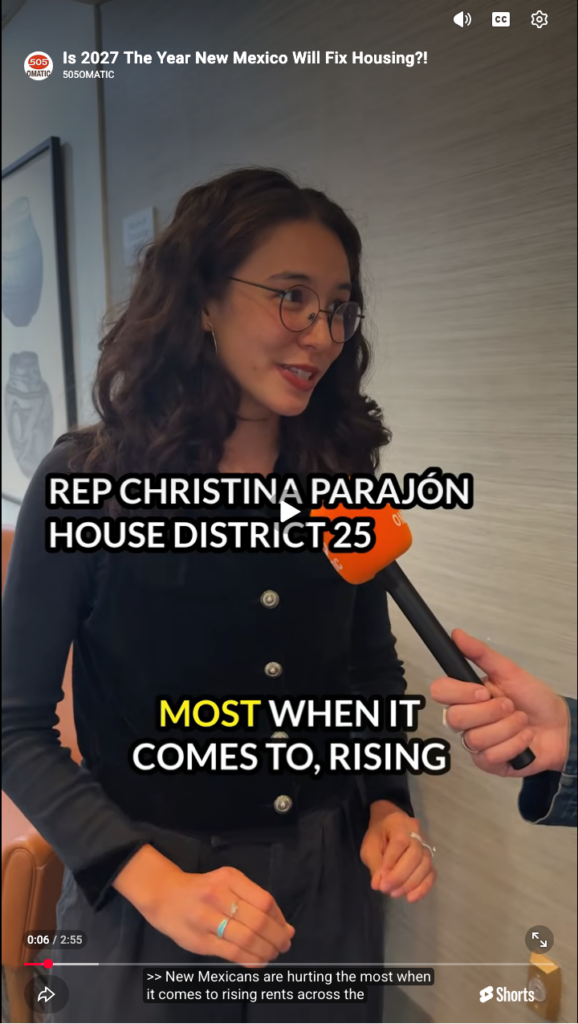
In collaboration with 505omatic, we’re sharing a video highlighting New Mexico’s housing shortage, the challenges facing our communities, and why the Housing Abundance! was formed.
Watch to learn more about our mission and the work ahead.
Housing is in crisis all over the country. But it’s especially dire here in New Mexico. A recent report from Housing New Mexico estimated that we need 58,000 units to address the housing shortage in our state. That’s why the Housing Abundance! Coalition formed. This cross-sector group of stakeholders is working together to develop a wide-ranging set of housing-related bills that will be introduced in the 2027 Legislative Session. The areas they are focusing on are: making it easier to build new housing; helping more people get access to housing they need; reforming tax policies; and developing rural housing incentives.
505OMATIC is partnering with the Housing Abundance! Coalition over the next few months to bring you stories about what challenges New Mexicans face when it comes to housing, and how this year might actually be the year we make some real change happen on the state level.
To learn more about the Housing Abundance! Coalition, please visit: https://housingabundance.org/
Get the Latest Updates on Immigration Enforcement in Free NAHB Webinar
NAHB is hosting a members-only webinar next month that will feature the latest updates on immigration enforcement practices and what members need to do to protect their businesses and their documented workers.
When ICE Comes Calling – Immigration Compliance and Updates, on Friday, Dec. 4 at 2 p.m., will feature guest speaker Laura Foote Reiff from the firm Greenberg Traurig. A global leader in business immigration, Reiff brings over 35 years of experience representing businesses on immigration and compliance.
Reiff will provide information about ICE and Border Patrol’s current enforcement tactics and what businesses can do to reduce their risk of immigration liability.
The webinar is in response to a flood of calls from NAHB members and HBAs. Many members are saying the aggressive enforcement actions of ICE agents are having a chilling effect on job attendance by documented workers, including U.S. citizens.
Register for the webinar. You must be an NAHB member and logged in to nahb.org to register. In addition, if you have any specific immigration enforcement questions for Reiff or NAHB legal staff, there is a place to submit questions on the registration form.
In advance of the webinar, read When ICE Comes Calling, a resource for home builders that lays out business owners’ rights and responsibilities when it comes to immigration enforcement. The video below highlights some of the most important points from the document.

This November Housing eJournal brought to you by Build Green New Mexico.
Construction Industries Division Watch – NM Timber and Single Stair Come Before Technical Advisory Committee
The November 16th meeting of the Construction Industries Division General Construction Technical Advisory Committee (TAC) was interesting for NMHBA members who were looking to utilize native timber in their construction projects and those interested in multi-family construction.
The native timber tables in the NM building and residential codes are aimed specifically at those who want to use locally harvested and milled wood products for purposes such as vigas and latillas. The law that passed in 2025 broadened the use of native timbers to all structural uses in buildings. That means the regulations being developed by the Forestry Department for training and certifying lumber graders in the state will also be expanded to all kinds of uses of native timber. And, that also means the NM building codes will need to expand their allowances of use for wood milled in the state beyond just vigas and latillas.
The Forestry Department provided a rough draft of their proposed handbook for training lumber graders, and it included good provisions such as the $250 cost of taking the 2-day training to become a lumber grader, and offering the training online. There was anecdotal reference to having a huge glue-lam beam constructed in New Mexico that had to be trucked to Montana so the lumber grading person there could inspect it and assess its load-bearing capabilities before it was then trucked back to New Mexico and installed in a commercial building here. The Department said they would look at the possibility of creating some kind of reciprocal licensing between other states with similar testing programs so NM might entice some of those folks to relocate here.
While the hope was to get the training in place and start production of native timber in the state by the summer of 2027, it appears that getting the graphics produced for inclusion in the handbook will take until the end of summer, so the Fall of 2027 is a more realistic outcome.
The multi-family side of the housing industry had hoped to be able to eliminate one stairwell in buildings up to 6 stories in height, but the comments from the building officials, State Fire Marshal & staff promise that request by the Office of Housing (under the Dept. of Workforce Solutions) will have a difficult path forward.
The original intention was to save floor-space by eliminating the requirement for two stairwells and thereby reduce the cost of construction – especially in conversions of older office buildings into residential use. The folks with knowledge of fire-fighting water pressure requirements pointed out that a large water tank would be required on the roof to provide gravity feed of water to the uppermost stories since the fire pumping units would not be able to reach to the top of a 6-story building. That tank would likely offset any cost savings by eliminating a stairwell. The Fire Marshal also stated that a wider stairwell that would be required to allow residents to come down while fire personnel with their heavy equipment were climbing up to fight the fire.
The discussion of the issue revealed quite a strong headwind for the proposal to pass the Legislature in 2027. The Office of Housing will look at how this requirement was eased in New York City and Seattle, and refine their proposal to see if it could be viable.
Colorado shows how politics can shift. Fire officials opposed a single-stair bill there in 2024, and it died in the legislature. Sponsors came back in 2025, worked closely with fire prevention specialists, and won passage of HB25-1273. The new law allows single-stair apartments up to five stories and four units per floor, with sprinklers throughout, fire-resistant construction and short walks to the stairway.
Elsewhere, fire officials remain largely opposed. The firefighters’ union (IAFF) warns that crews using the stairwell can block residents from getting out. The savings look promising but aren’t proven: Pew estimates a second stair takes up about 7% of floor space and adds 6–13% to construction costs. Single stairs are also allowed in Tennessee, Vermont, Washington, New York City, Seattle and Honolulu.
NMHBA will continue to follow development of this potential cost saving measure on behalf of members and partner organizations who build these projects.
Heinrich’s Bipartisan American Affordability and Jobs Act (BAAJA) Opens Doors to Affordable Housing and Electrons to Power Them [SUPPORT]
Miles D. Conway
A young country in its building phase creates opportunities for community builders, engineers, and architects. A mature country, in its negotiating phase, creates opportunities for elaborate regulation, rewarding only those who can navigate complexity. That’s a generous paraphrase of a concept from Ezra Klein and Derek Thompson’s 2025 book “Abundance.” It’s also a very real phenomenon at the heart of housing unaffordability in 2026. Regulatory barriers, permitting roadblocks and higher development fees are key constraints driving rent and home costs up for residential construction—constraints lawmakers in the U.S. House of Representatives can address this year.
Affordable housing projects, and the renewable energy to power them, are increasingly stalled by well-meaning but slow, costly, duplicative reviews that result in good projects being unaffordable or abandoned altogether.
That’s why the New Mexico Home Builders Association welcomed Senator Martin Heinrich’s work to fix burdensome federal permitting. As Ranking Member of the Committee on Energy and Natural Resources, he helped negotiate the Bipartisan American Affordability and Jobs Act (BAAJA) and secure passage in the U.S. Senate. BAAJA refocuses the National Environmental Policy Act (NEPA) on true major federal actions, ensuring affordable housing would no longer face review simply for receiving federal funding – a change that can help create housing New Mexico desperately needs.
Earlier this year, the New Mexico Mortgage Finance Authority reported that half of New Mexico renters are cost-burdened. Builders are narrowing the supply gap, but most recent permits have been for single-family homes, not multifamily buildings that bring more rental options to market.
Single-family builders face crippling delays too, but comparatively lighter regulation. According to the National Association of Home Builders, federal, state and local regulations account for more than 40% of a new multifamily development cost – enough to make projects financially unworkable.
Federal housing finance programs are a key example of this regulatory burden. Multifamily projects seeking a federal loan or grant for affordable housing must undergo NEPA review as a funding condition. These reviews add cost and delay, largely duplicate local reviews of water and soil protections, and make federal financing tools harder and costlier to use.
Those costs don’t stay on a developer’s balance sheet. They become higher rents, fewer units, and abandoned projects. Modernizing permitting through BAAJA would not eliminate responsible oversight; it would help ensure public and private dollars produce actual homes, not avoidable delay.
Federal, State, and Local housing assistance should make projects more feasible, not trigger processes that drain scarce resources before construction begins. By focusing review where federal involvement is truly substantial, Congress can preserve environmental accountability while letting routine, locally approved housing move forward predictably.
BAAJA’s bipartisan support shows that building homes and protecting the environment aren’t competing goals. Clear agency timelines, better coordination, fewer post-review legal challenges and greater certainty for project sponsors can speed construction while preserving core safeguards – benefits that extend to energy, transportation and public works projects, too.
There’s controversy and misunderstanding around this legislation. Advocacy groups understandably fear the bill could weaken key environmental reviews, overlook water protections or rush consultation with sovereign tribal communities. But Senator Heinrich has spent decades championing environmental causes and Indigenous communities in New Mexico. He’s earned a measure of trust that the Bill as crafted will enable adequate protections, consultations with impacted communities, and strike the balance we need between stewardship and the housing and renewable energy sector growth our state needs.
New Mexico’s housing challenge is urgent and it’s one builders are proud to address. The stakes are real for working families, seniors and young people hoping to stay in their communities they call home, especially rural areas needing economic and housing renewal. Every month of unnecessary delay raises financing and construction costs and pushes attainable housing farther out of reach.
We applaud his leadership, and the Senate for passing the bill. I encourage the House of Representatives to pass meaningful permitting reform this year that helps turn housing investment into completed quality homes for New Mexicans.
Have a topic that the NMHBA staff should cover in a future Housing eJournal? Let us know: Info@NMHBA.org | 505.344.7072.