
Advocacy
New Mexico Home Builders Association – Partnering for Housing Solutions
We advocate for policies, legislation, and codes that promote safe, sustainable, and affordable housing opportunities for all New Mexicans. The home building and construction industry is a driving force in the state's economy and since 1959 NMHBA has been trusted resource for housing solutions.
To view and locate the twenty-five (25) Bills NMHBA is tracking at the 2026 Session – CLICK Here for our shared Roundhouse Locator.
For a complete members-only summary & analysis of bills, including those we're supporting, opposing, and assessing, email Melanie Lawton, NMHBA Director of Government Affairs.
Partnering for Housing Solutions at State & Local Government Levels
New Mexico's Path to Housing Affordability
A 7-Point Plan
-
increase housing production and close the affordability gap between income and home prices;
-
encourage neighborhood revitalization and residential redevelopment; and
-
allow New Mexicans to realize the dream of home ownership and build generational wealth.
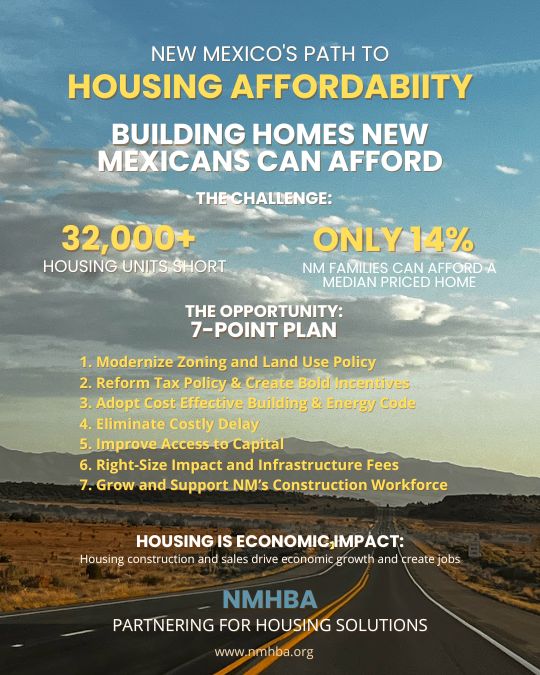
A Statewide shortage of at least 32,000 housing units makes it increasingly difficult for New Mexico families to afford to buy or rent a home. People are PRICED-OUT with Fewer than 14% of NM residents able to afford the mortgage on a median-priced home. NMHBA provides this housing platform designed to tame shelter inflation and ease the housing affordability challenge by reducing barriers that hinder the construction of new homes and apartments.
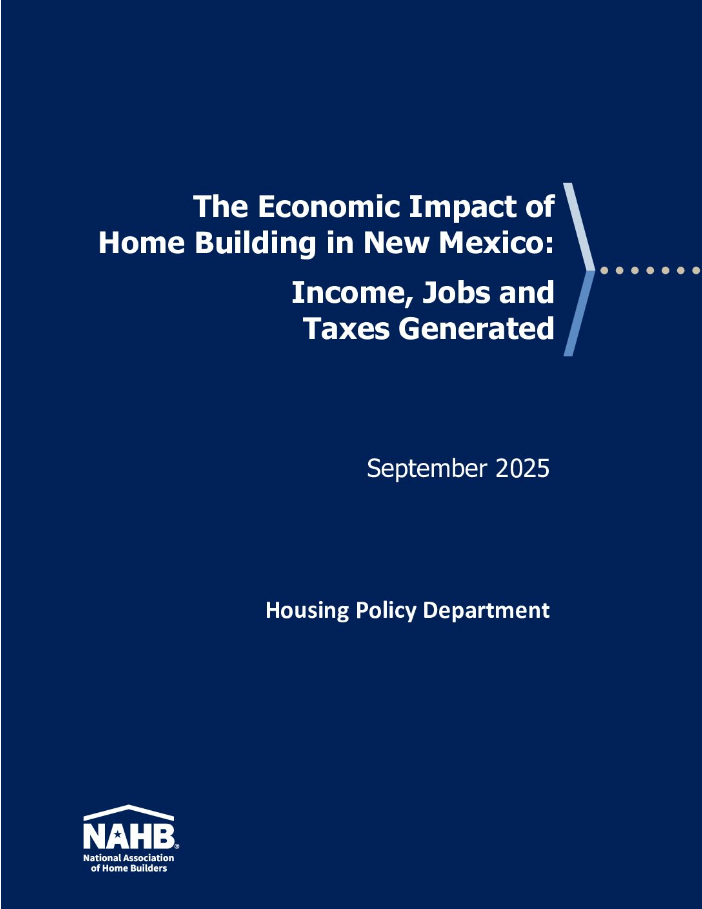
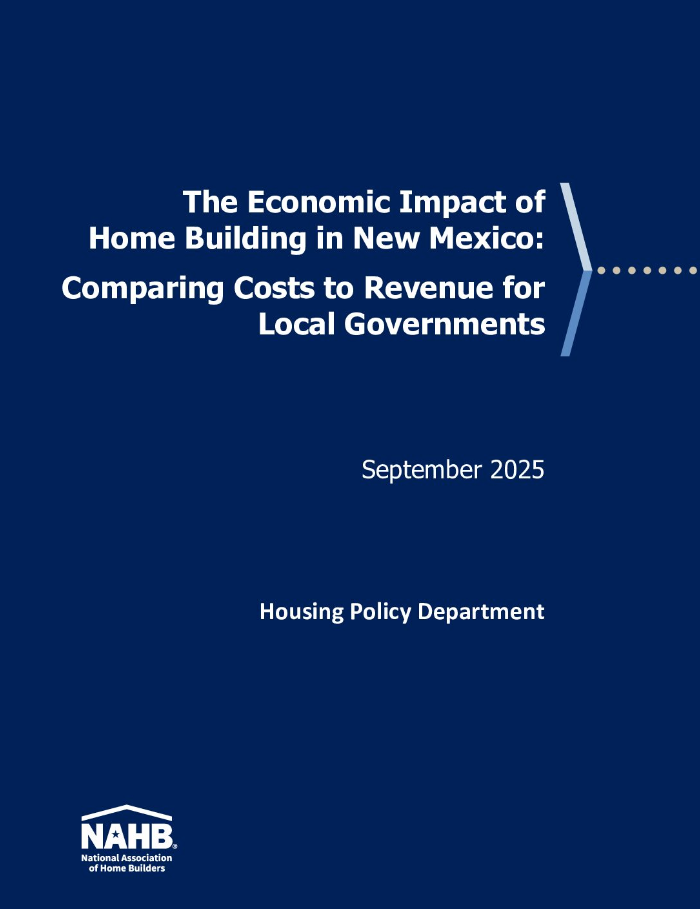
Click Images to Download 09-2025 NAHB Reports on Positive Economic Impacts of Housing New Mexico.
Report #1: The Economic Impact of Home Building in New Mexico: Income, Jobs and Taxes Generated
Report #2: Comparing Costs to Revenue for Local Governments
The Challenge:
Build Housing NM People can Afford
-
- Regulatory costs and Gross Receipts Tax (GRT) account for up to 30% of the price of a new home, making housing less attainable. An average-priced new NM home ($441K) includes over $35K in GRT taxes, approximately 200% of the tax burden of surrounding states.
-
- New Mexico is short more than 32,000 housing units with the largest gaps occurring in workforce housing.
-
- Urban areas like Albuquerque, Las Cruces, and Santa Fe face high land and construction costs, driving up prices and limiting supply. Rural communities face challenges of limited housing stock, aging infrastructure, and fewer developers, making it hard to find quality homes.
-
- Median home prices in New Mexico rose 40% since 2019, while wages have not kept pace.
-
- Nearly 1 in 3 renter-households in NM are cost-burdened, spending more than 30% of their income on rent.
-
- The State of New Mexico has failed to set housing goals and build consensus on how to reach them.
The Opportunity:
Home Building IS Economic Development
-
- In year #1, building 100 new homes in NM supports 500+ good-paying jobs and results in $8.7M tax revenue to local and state governments. (1)
-
- For every new single-family home built in New Mexico, over $60K in GRT and other tax revenue is generated. This far out paces the investment needed from state or local governments to stimulate production. (2)
-
- Solutions that lower costs home buyers pay for off-site infrastructure improvements can cut the cost of an average-priced NM home by 2.5% (approx. $10,000 on a single-family home.)
-
- Reducing the state's significant tax burden on attainable/workforce housing units could reduce the average priced home by at least 3.0%.
-
- New Mexico's housing industry supports over 50,000 jobs and contributes billions to the state's economy annually.
1.) NAHB Housing Policy Dept Report: The Economic Impact of Home Building in New Mexico – 09/2025
2.) NAHB Report: Comparing Costs to Revenue for Local Governments – 09/2025
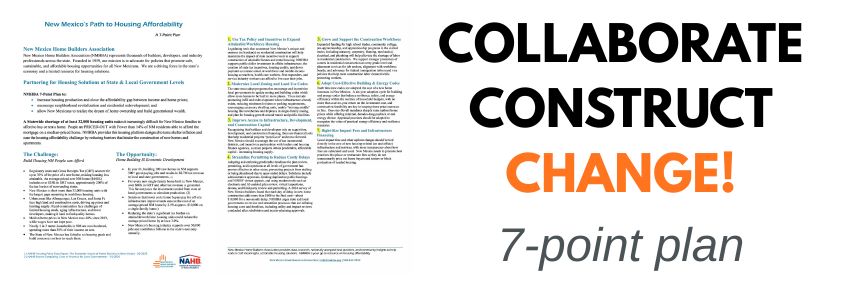
7-POINT PLAN – NM Path to Housing Affordability
1. Use Tax Policy and Incentives to Expand Attainable/Workforce Housing
Legislating tools that counteract New Mexico's unique and onerous tax burden(s) on residential construction will help maximize the impact of state incentive tools to support the construction of attainable homes and rental housing. NMHBA supports public dollar investment in offsite infrastructure, the creation of state tax incentives, housing credits, and down payment assistance aimed at workforce and middle-income housing so teachers, health care workers, first responders, and service industry workers can afford to live near their jobs.
2. Modernize Local Zoning and Land Use Codes
The state must adopt programs that encourage and incentivize local governments to update zoning and building codes which allow more homes to be built in more places. These include promoting infill and redevelopment where infrastructure already exists, reducing minimum lot sizes or parking requirements, encouraging accessory dwelling units, enable "missing middle" housing like townhomes and duplexes in single-family zoning, and plan for housing growth around transit and public facilities.
3. Improve Access to Infrastructure, Development, and Construction Capital
Recognizing that builders and developers rely on acquisition, development, and construction financing, there are financial tools that help residential projects "pencil-out" and move forward. New Mexico should encourage the use of tax incremental districts, and incentivize partnerships with lenders and housing finance agencies, so more projects obtain predictable, affordable capital – increasing housing supply.
4. Streamline Permitting to Reduce Costly Delays
Adopting and enforcing predictable timelines for plan review, permitting, and inspections at all levels of government has proven effective in other states, preventing projects from stalling or being abandoned due to open‑ended delays. Solutions include administrative approvals, limiting duplicative public hearings and NIMBY‑driven appeals, and using modern tools such as electronic and AI‑assisted plan review, virtual inspections, drones, and third‑party review and permitting. A 2024 survey of New Mexico builders found that each day of delay in new home construction adds more than $150 to the final cost—about $4,500 for a one‑month delay. NMHBA urges state and local governments to review and streamline processes that are inflating housing costs and timelines, including utility and impact reviews conducted after subdivision and master‑planning approvals.
5. Grow and Support the Construction Workforce
Expanded funding for high school trades, community college, pre-apprenticeship, and apprenticeship programs in the skilled trades, including masonry, carpentry, framing, mechanical, electrical, and plumbing will help alleviate the shortage of labor in residential construction. We support stronger promotion of careers in residential construction at every grade level and placement services for job seekers, alignment with workforce boards, and advocacy for federal immigration reform and visa policies that help meet construction labor demand while protecting workers.
6. Adopt Cost-Effective Building & Energy Codes
Each time new codes are adopted, the cost of a new home increases in New Mexico. A six-year adoption cycle for building and energy codes that balance resilience, safety, and energy efficiency within the realities of household budgets, with no more than a seven-year return on the investment cost, and construction feasibility are key to keeping these price increases in line. One-size-fits-all mandates sharply raise upfront home prices while offering minimal, decades-long payback or end energy choice. Appraisal practices should be adopted to recognize the value of practical energy efficiency and resilience measures.
7. Right-Size Impact Fees and Infrastructure Financing
Local impact fees and other upfront charges should be tied directly to the cost of new housing-related (on and offsite) infrastructure and services, with more transparency about how fees are calculated and used. New Mexico needs to promote best practices that phase or restructure fees so they do not unnecessarily price out home buyers and renters or block production of needed housing.